
How RL Boosting is Evolving in Virtual Reality?
As gaming transitions into more immersive environments, virtual reality (VR) is reshaping not only how players experience games, but also how services like RL boosting is delivered. Traditional boosting models are more focused on rank climbing, level progression, or unlocking achievements. All of which are consistently evolving to meet the demands of spatial interaction, real-time engagement, and skill-based gameplay.
In VR ecosystems, boosting is no longer just about outcomes. It is increasingly about experience, participation, and guided improvement within fully interactive digital worlds.
From Passive Progression to Active Participation
When compared to conventional games, boosting often involves a degree of passivity. Players have the ability to outsource progression tasks, allowing a third party to handle gameplay while they receive the results. By integrating this model, it works in environments driven by inputs like mouse clicks and keyboard commands.
By incorporating VR on the other hand, this changes the whole dynamic.
Because gameplay relies on physical movement, spatial awareness, and real-time interaction, boosting becomes a more collaborative process. Instead of handing over control, players remain present in the environment, actively engaging while receiving assistance.
This movement transforms boosting from a transactional service into a shared experience, where progress is achieved through participation rather than delegation.
Skill-Based Assistance in Immersive Environments
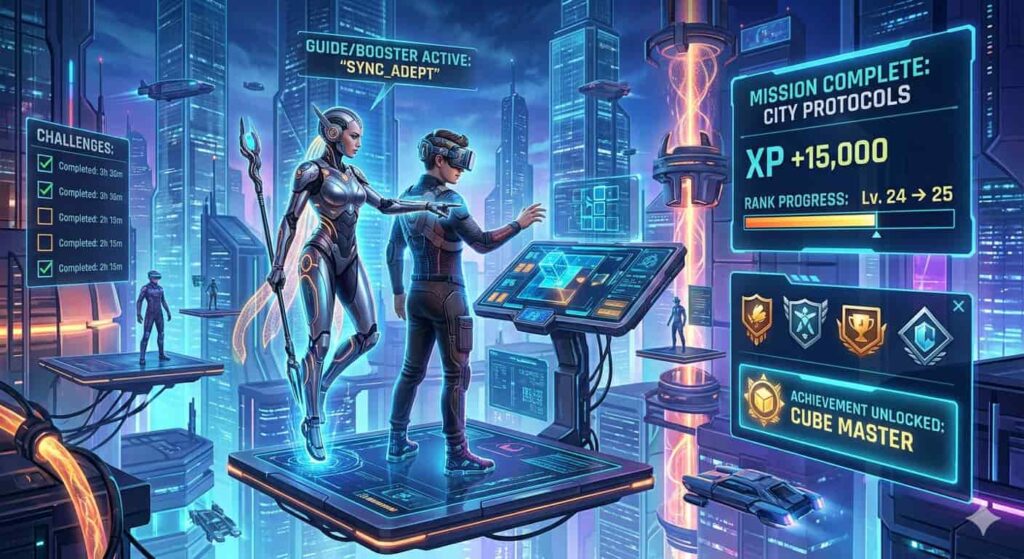
One of the most significant changes VR introduces is the emphasis on skill development. In immersive games, success often depends on coordination, timing, and environmental awareness. All of these are skills that cannot be easily replicated or transferred through traditional boosting methods. As a result, boosting in VR extends into areas such as real-time coaching within the game environment, guided walkthroughs for complex challenges, cooperative gameplay sessions with experienced players, hands-on demonstrations of techniques and strategies and many more.
This approach accelerates learning while preserving engagement. Players are not just progressing, they are improving their capabilities within the game.
Technical Demands and Infrastructure Challenges
VR environments introduce new layers of technical complexity that directly impact boosting services. Unlike traditional setups, VR relies on:
- Motion tracking systems
- High frame rate rendering
- Low-latency network connections
- Synchronized user presence
Any disruption such as lag or tracking inaccuracies, can significantly affect gameplay quality. For boosting providers, this means that infrastructure must be more robust and responsive. Coordinating sessions in VR also requires precise timing and system compatibility between users. Ensuring stable connections and synchronized interactions becomes essential for delivering consistent results.
These technical demands elevate the operational standards of boosting services, requiring advanced systems and careful execution.
The Rise of Collaborative Boosting Models
VR naturally encourages collaborative boosting models, where players and service providers interact within the same virtual space. Instead of a one-sided service, boosting becomes a cooperative effort. Because by implementing this model, it makes it possible for:
- Experienced players guide others through challenges in real time
- Teams work together to complete objectives
- Learn and progress happen as a team
This approach aligns with the social nature of VR, where presence and interaction are central to the experience. It also reduces concerns related to account sharing, as players maintain control while receiving assistance. Collaborative boosting represents a shift toward integration rather than substitution, blending support with active gameplay.
Redefining Value in Next-Generation Boosting
As VR continues to evolve, the definition of value in boosting services is changing. Traditional metrics such as rank or level, remain relevant, but they are no longer the sole indicators of success. In immersive environments, value is also measured by a number of things similar to skill acquisition and improvement, efficiency in learning complex mechanics, quality of interaction and guidance, overall gameplay experience.
This broader perspective reflects the unique nature of VR, where progression is deeply tied to player ability and engagement.
A New Era of Immersive Support
Virtual reality is pushing the boundaries of what game boosting can be. By introducing spatial interaction, real-time collaboration, and skill-based progression, it transforms boosting from a background service into an integral part of the gameplay experience.
As the industry adapts, providers must embrace more interactive and technically sophisticated models. Players, in turn, benefit from a more engaging and educational approach to progression. In this next-generation landscape, boosting is no longer just about reaching the destination, it is about enhancing the journey within immersive digital worlds.


